
Abdul El-Sayed Makes History as First Muslim U.S. Senator
Thomas Hale
Updated Nov 9, 2026
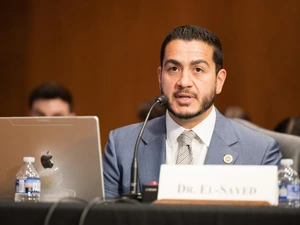
Caption: Abdul El-Sayed testifies at a U.S. Senate committee hearing in 2024. Credit: U.S. Senate HELP Committee / Public Domain, via Wikimedia Commons.
Abdul El-Sayed won Michigan’s U.S. Senate race on November 3, defeating Republican Mike Rogers and becoming the first Muslim elected to the chamber. The victory preserved a Democratic-held seat during a midterm election that delivered his party Senate control, but it also marked a personal milestone unlike any of the other results that night.
El-Sayed entered the race as a physician and former Detroit health director, not as an incumbent member of Congress. His professional background in public health shaped the profile he presented to voters, while his candidacy drew national attention because the Senate had never before included a Muslim member. The Guardian reported that he declared victory at Democratic headquarters in Detroit early Wednesday.
The campaign took place against the backdrop of an intensely contested national election and arguments over the future of health care, the cost of living and U.S. foreign policy. Religion also became an issue in the race. The Guardian described criticism and attacks focused on El-Sayed’s Muslim identity, alongside disputes over his progressive politics. The historical result can be reported without assigning a single motive to Michigan’s voters.
From Detroit health administration to a statewide race
El-Sayed’s career included leading Detroit’s health department, a municipal role focused on protecting community health. That experience put him in direct contact with public-service questions before his election to federal office. He previously sought statewide political office and became known as a progressive Democrat, giving his Senate candidacy a longer political history than the November vote alone.
Rogers, a former Republican congressman, brought a contrasting political and professional background to the contest. The race therefore paired a public-health administrator and progressive candidate against a veteran Republican politician. Reporting on the campaign described a divisive contest that unfolded while Democrats were defending their Michigan Senate seat and contesting Republican-held seats elsewhere.
The distinction between holding Michigan and flipping another state mattered to the national result. Democrats needed to retain seats already in their column while winning additional races to secure a Senate majority. El-Sayed achieved the first objective, even as other Democratic candidates produced the historic party changes in Kansas, Texas, South Carolina and North Carolina.
A first in a chamber with a different history
Muslim Americans had served in the U.S. House before 2026, but none had won a Senate election. El-Sayed’s win changed that history while placing a new public-health voice among the chamber’s incoming members. The result also underscored that the two congressional chambers have reached representation milestones on different timelines.
The first immediate consequence is representation: Michigan’s next Senate delegation will include a member whose religious background had never previously been represented in that body. The second will depend on the committee assignments and legislative proposals that take shape when the chamber organizes in January. Those concrete assignments, rather than a generic description of senatorial duties, will show how his earlier health-policy work translates into federal office.
El-Sayed is scheduled to join the new Senate in January 2027. His election-night declaration in Detroit supplied the defining moment; the subsequent session will establish the specific legislative role he takes on.
References: Progressive Abdul El-Sayed wins Michigan Senate race to become first Muslim US senator | Democrats win big in midterm elections

AI-Assisted Content
The News And Beyond team was assisted by generative AI technology in creating this content.
Trending

Health Savings Limit Rises to $9,000. Medicare Can End Your Contributions
Americans with qualifying health insurance will be able to contribute up to $9,000 to a...
Laura Bennett


Renters Could Share $48.5 Million in Settlement Funds
Renters affected by alleged hidden fees and improper security-deposit deductions at Progress Residential could receive...
Ryan Ellis


Companies Got Tariff Refunds. Some Money Went to Bonuses
Stanley Black & Decker raised prices while import tariffs increased its costs. Now the tool...
Thomas Hale

Hilary Swank, Pregnant at 52, Tells Critics to Get With the Times
Caption: Hilary Swank at the 2015 Tokyo International Film Festival. Photo: Dick Thomas Johnson /...
Susan Blake

Medicaid Work Rule Deadline Pushed Back Six Months
Caption: President Donald Trump with Dr. Mehmet Oz and Health Secretary Robert F. Kennedy Jr....
Erin Calloway


New Food Aid Proposal Could Affect Millions of Families
The Trump administration has proposed tightening the rules used to qualify households for food assistance,...
Thomas Hale


IRS Raises 2027 401(k) Limit to $25,500, With Bigger Catch-Ups After 50
Workers will be able to put more money into many workplace retirement plans next year....
Alex Mercer


NASA Tracks a Giant Star Swallowing Its Smaller Neighbor
Astronomers have reconstructed a rare cosmic event in which a giant, aging star swallowed a...
Erin Calloway

Nationwide FAA Ground Stop Strands Thousands of Travelers
A nationwide Federal Aviation Administration ground stop on Friday brought U.S. departures to a halt...
Thomas Hale

Kellie Pickler Settles Fight Over Late Husband's Property
Caption: Kellie Pickler performing live, July 2007. Credit: minds-eye / CC BY-SA 2.0, via Wikimedia...
Emily Carter